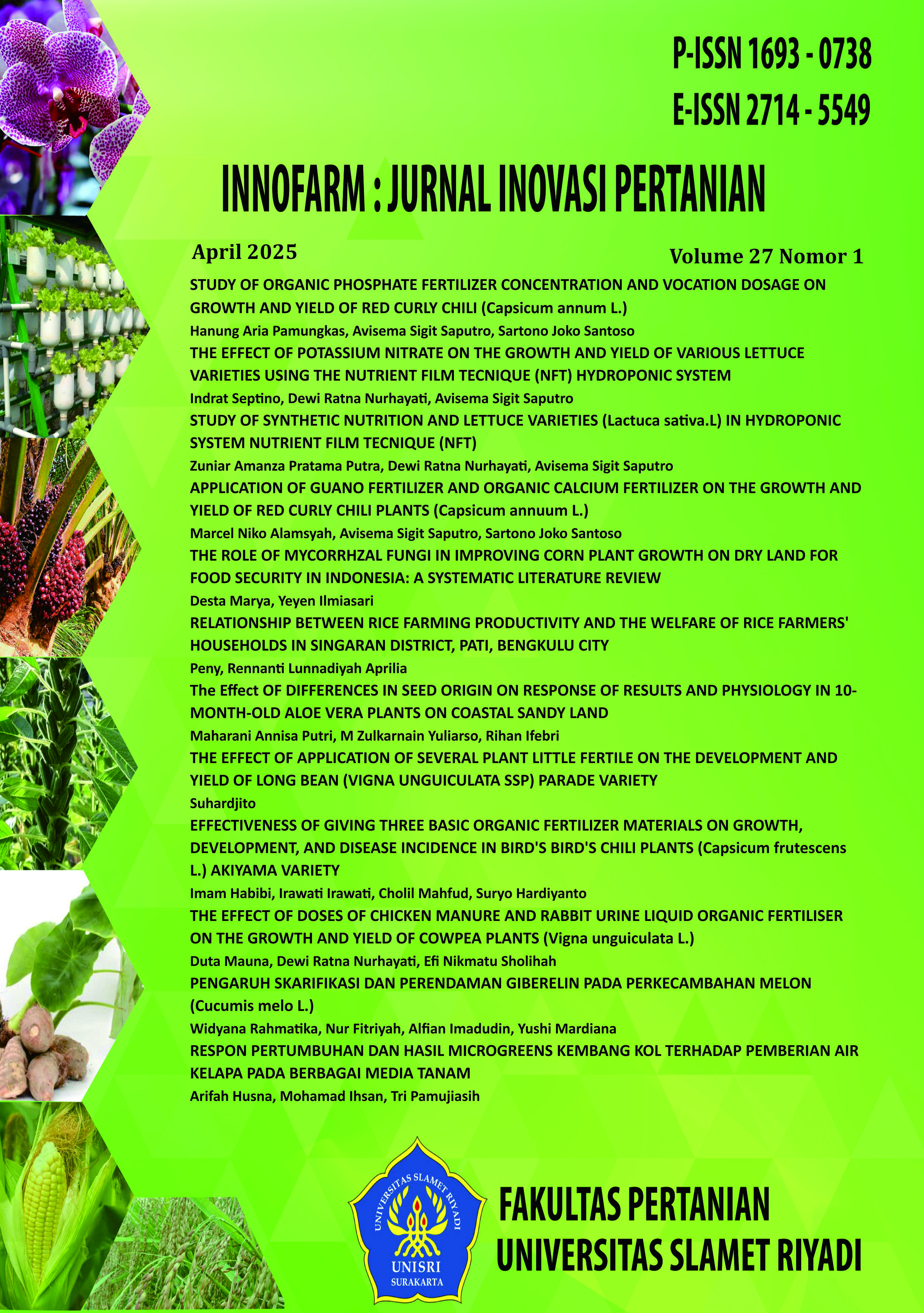
STUDY OF ORGANIC PHOSPHATE FERTILIZER CONCENTRATION AND VOCATION DOSAGE ON GROWTH AND YIELD OF RED CURLY CHILI (Capsicum annum L.)
Chili, Fertilizer, Organic, Phosphate, Vermicompost
DOI:
https://doi.org/10.33061/innofarm.v27i1.12433Abstract
The source of plant nutrients comes from the application of fertilizer. Inorganic fertilizers if used excessively for a long time will have a negative impact on the soil and plants. Organic fertilizers are needed to maximize the productivity of chili plants and improve soil quality. The purpose of this study was to test the effect of organic phosphate fertilizers and vermicompost on the growth and yield of curly red chili plants (Capsicum annum L.). The research method was a Completely Randomized Design (CRD) with two factors, obtained 16 treatments with 3 replications. The treatment factors for organic phosphate fertilizers were 0 ml/liter, second 10 ml/liter, third 20 ml/liter, 30 ml/liter and vermicompost 0 tons/ha, 5 tons/ha, 7.5 tons/ha, 10 tons/ha. The results of the research data were analyzed using Analysis of Variance (ANOVA). Then if there is a significant difference, it is continued using the Honestly Significant Difference Test (HSD) at a level of 5%. From this study, the results obtained were that organic phosphate fertilizer treatment affected leaf color, weight and length of fruit per plant. The vermicompost dose showed an effect on plant height, number of leaves, and fruit weight per plant. The interaction of organic phosphate fertilizer and vermicompost affected the number of fruits and fruit weight per plant. The concentration of POC phosphate of 30 ml/liter and the dose of vermicompost of 10 tons/ha affected the growth and yield of curly red chili plants (Capsicum annum L.).
Downloads
Published
Issue
Section
License
Copyright (c) 2025 Hanung Aria Pamungkas, Avisema Sigit Saputro, Sartono Joko Santoso

This work is licensed under a Creative Commons Attribution-NonCommercial 4.0 International License.
Authors who publish this journal agree to the following terms:
- Authors retain copyright and grant the journal right of first publication with the work simultaneously licensed under a Creative Commons Attribution License that allows others to share the work with an acknowledgement of the work's authorship and initial publication in this journal.
- Authors can separately make additional contractual arrangements for non-exclusive distribution published by the journal (e.g., publish it in a book), with an acknowledgement of its initial publication in this journal.
- Authors are allowed and encouraged to send their work via online (e.g., in the institutional repositories or their website) after published by the journal.